Frank family goes into hiding
Diary of Anne FrankFrank family goes into hiding marks the sudden passage from threatened ordinary life to concealed existence under German occupation. A plan made to avoid seizure and deportation becomes urgent when Margot receives a call-up notice; on July 6, 1942, the family leaves home in layered clothes and carries what it can, walking through the rain to Otto Frank’s office building. The transition is at once a flight from danger and the start of a life governed by hiding, silence, and the help of a small circle of trusted people.
Background: Restrictions and a plan
The move followed a sustained narrowing of Jewish life in the Netherlands. After the German occupation, anti-Jewish decrees required Jews to wear the yellow star and surrender bicycles, restricted shopping to specified hours, barred Jews from public transport and many places of recreation, and imposed a nighttime curfew. Anne records the cumulative pressure in the repeated pattern of what Jews could no longer do: the restrictions reached into movement, education, work, and ordinary social contact. The family’s decision to hide was made against this background, not as a sudden escape from an otherwise secure life.
Otto Frank had already been preparing. While walking with Anne around their neighborhood square, he explained that for more than a year they had been moving clothes, food, and furniture to other people. The family did not want their possessions seized by the Germans, nor did they want to fall into German hands. His plan was to leave of their own accord rather than wait to be taken away. He also told Anne that life cut off from the rest of the world would be difficult, but initially urged her to enjoy her carefree life while she could.
That conversation gave the plan a practical and emotional shape without yet telling Anne when or where it would happen. The intended departure date was July 16. Margot’s call-up notice abruptly advanced it by ten days, forcing the family to act before preparations were complete. The sudden change—from a guarded future possibility to an immediate necessity—is the event’s central reversal.
The call-up and the decision to leave
The crisis began on a Sunday afternoon. Anne was reading on the balcony when the doorbell rang; she did not hear it. Margot appeared in the kitchen looking agitated and told her that a call-up notice had arrived. At first Anne understood it as a summons for Otto. The prospect brought visions of concentration camps and solitary confinement, and she and Margot waited in silence while Edith went to consult Otto’s business partner, Hermann van Pels.
Margot then told Anne that the notice was for her, not their father. At sixteen, she was apparently to be sent away alone. Anne began to cry; the news made the danger immediate and personal, and she understood that the family would not let Margot go. The decision to move into hiding, previously discussed by their father, now became the alternative to the call-up. The sisters still did not know where the refuge was or how they would reach it. Anne’s mind filled with questions about whether they would hide in the city or countryside, in a house or a shack, but she was not allowed to ask them.
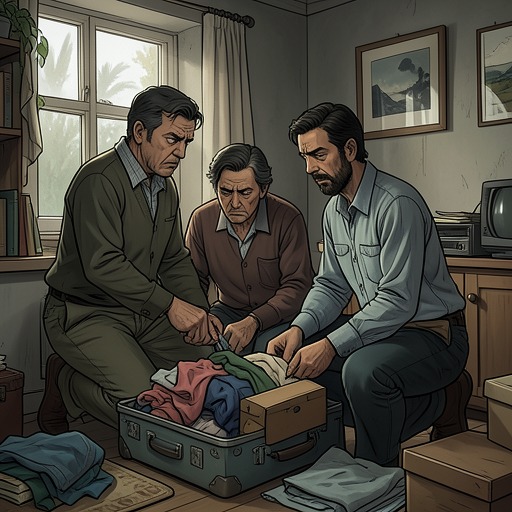
They began packing the belongings that mattered most into a schoolbag. Anne put the diary in first, followed by curlers, handkerchiefs, schoolbooks, a comb, and old letters. She admitted that preoccupation made her pack some strange things, but did not regret doing so. The diary’s place at the top of the bag makes the departure more than a transfer of possessions: the record of her life went with her into the unknown.
Departure and the journey
The family prepared to leave under conditions that made concealment visible even before they reached the refuge. The night before, Miep and Jan Gies had carried away shoes, stockings, books, and underwear in their bags and pockets. Anne knew it would be her last night in her own bed, yet exhaustion made her fall asleep quickly. At five-thirty the next morning her mother woke her.
To avoid drawing attention by carrying a suitcase full of clothes, the family wore as much as it could. Anne describes two undershirts, three pairs of underpants, a dress under a skirt, a jacket, raincoat, two pairs of stockings, heavy shoes, a cap, and a scarf. She was already suffocating before leaving the house, but the need to bring extra clothing outweighed her discomfort. The body itself became luggage: each layer concealed another part of the family’s preparations while making the journey harder.
Margot left first, with her schoolbag full of books. She took her bicycle and rode ahead with Miep, while Anne still did not know the destination. At half past seven, Otto, Edith, and Anne closed the door behind them. Anne’s only farewell to a living creature at home was to Moortje, her cat, who was to be taken to the neighbors and given a good home. The family’s departure thus included a small, deliberate effort to provide for the pet they could not take.
On the walk, Otto and Edith gradually disclosed the plan. The family had been preparing for months to move into hiding on July 16, but Margot’s notice had brought the date forward. In the pouring rain, Anne walked with her parents, each carrying a schoolbag and a shopping bag filled with a varied assortment of belongings. Passersby on their way to work looked sympathetic; the yellow star made the reason for their flight legible, even when the family could not explain it aloud.
The refuge in the office building
The hiding place was in Otto’s office building, at 263 Prinsengracht. The choice joined concealment to the family’s existing working world: Otto’s firm operated there, and only a limited group of office workers knew the family was coming. These included Victor Kugler, Johannes Kleiman, Miep, and Bep Voskuijl, a twenty-three-year-old typist. Bep’s father, Mr. Voskuijl, worked in the warehouse with two assistants, none of whom had been told. Knowledge was deliberately restricted, making the helpers’ discretion part of the refuge’s security.
When the family arrived, Miep led them through a long hallway and up a wooden staircase into the Annex, then shut the door behind them. Margot, who had arrived much earlier by bicycle, was already waiting. The building’s ordinary commercial spaces and the concealed rooms above them formed two worlds within one address: a working office and warehouse below, a hiding place beyond the closed door.
The new rooms were not ready for living. Boxes sent to the office during the preceding months covered floors and beds; the small room was packed with linens from floor to ceiling. Edith and Margot were too exhausted to move and lay down on bare mattresses. Otto and Anne began unpacking, filling cupboards, hammering nails, and clearing the rooms. They worked until nightfall and fell into clean beds exhausted, having gone without a hot meal. Arrival brought safety from immediate pursuit, but not comfort: the family had crossed the threshold into a refuge that had to be made habitable by hand.
A refuge under continuing pressure
The move did not end the danger; it changed its form. The Secret Annex remained vulnerable to discovery, and later breaches at the warehouse required strict precautions. During one break-in, Peter found both the warehouse door and the street door open. He informed Otto, who tuned the radio to a German station and locked the private office before they went upstairs. The residents were instructed not to wash or run water, to keep quiet, to be dressed by eight, and not to use the bathroom. The burglars had forced the doors with a crowbar and stolen cashboxes, blank checkbooks, and coupons for 330 pounds of sugar. The episode shows how the office building that sheltered the family also exposed them to the risks of its public-facing business.
After a later security scare, the residents’ daily arrangements tightened further. Dr. Dussel was to work in the bathroom, Peter was assigned to patrol the house between eight-thirty and nine-thirty, and he could no longer leave his window open after someone from the Keg company had noticed it. The toilet could not be flushed after nine-thirty at night. A night watchman, Mr. Sleegers, was hired, and an underground carpenter was expected to build a barricade from the white Frankfurt bedsteads. The family and their helpers had to assess whether the watchman could be trusted, whether dogs would bark at someone behind the door, and how the barricade should be made. Hiding required not only a secret location but a continuing system of rules, watchfulness, and improvised defenses.
Anne’s account gives the relocation its wider meaning through the contrast between the family’s desire for a life of their own and the obligations forced on them as Jews. They were, she wrote, chained to one spot, without rights but with a thousand obligations. Her statement that one day Jews would again be people, not merely Jews, carries both the pain of exclusion and a hope that the war would end. The family’s entrance into hiding is therefore not a completed escape: it is the beginning of a precarious, confined life whose safety depends on concealment and solidarity, while its written record preserves the concrete steps by which persecution remade an ordinary household’s existence.